
Darren Chastney | 2 September 2026
The debate about artificial intelligence in academic publishing often swings between two extremes. On one side are predictions that AI will transform scholarly writing. On the other are warnings that it will undermine research integrity. Both positions miss something important. The real issue is not whether AI can produce academic content. It is who takes responsibility for that content once it enters the scholarly record.
Over the past year, AI has become part of everyday academic writing.
Researchers use it to improve language, summarise notes, refine drafts and assist with translation. Publishers are developing policies. Universities are issuing guidance. Editors are encountering manuscripts that have, to varying degrees, been shaped by AI systems.
The conversation has changed remarkably quickly.
A year ago, much of the discussion centred on capability. Could AI write an abstract? Could it produce a literature review? Could it generate text that was good enough to pass editorial scrutiny?
Those questions are no longer especially interesting. We already know that AI can produce convincing prose. In many cases, it can produce very convincing prose.
What matters now is how publishers respond.
A recently published policy from Cambridge Scholars Publishing offers a useful glimpse of where parts of the industry may be heading. The document places responsibility firmly on authors, stating that authors remain accountable for every word, claim, quotation, reference, citation, data point and conclusion submitted under their name. The use of AI tools, editorial assistance or third-party services does not transfer that responsibility elsewhere.
What stands out to me is that the policy does not treat AI itself as the problem.
Language polishing, spelling correction, translation support, formatting and accessibility assistance are all listed as acceptable uses, provided authors retain control of the meaning and verify the final content.
That feels like a pragmatic position.
Most authors are already using some form of AI-assisted language support, whether publishers openly acknowledge it or not. Pretending otherwise serves little purpose. The more sensible question is where assistance ends and authorship begins.
The policy draws a clear line around activities that jeopardise research integrity. It identifies as unacceptable the submission of AI-generated scholarly analysis as original research, AI-generated literature reviews without independent source verification, fabricated references, fabricated evidence and the concealment of material AI use. [cambridges…holars.com]
In other words, the concern is not technology for its own sake.
The concern is reliability.
This becomes particularly clear in the policy’s treatment of hallucinations. It distinguishes between factual hallucinations, fabricated references, incorrect citations and situations where fragments of genuine sources are combined into a source or conclusion that does not actually exist. The policy notes that such errors are especially serious because they may contaminate the scholarly record.
Anyone involved in academic editing will recognise the issue immediately.
A sentence can be eloquent and entirely wrong.
A citation can look perfectly plausible and not exist.
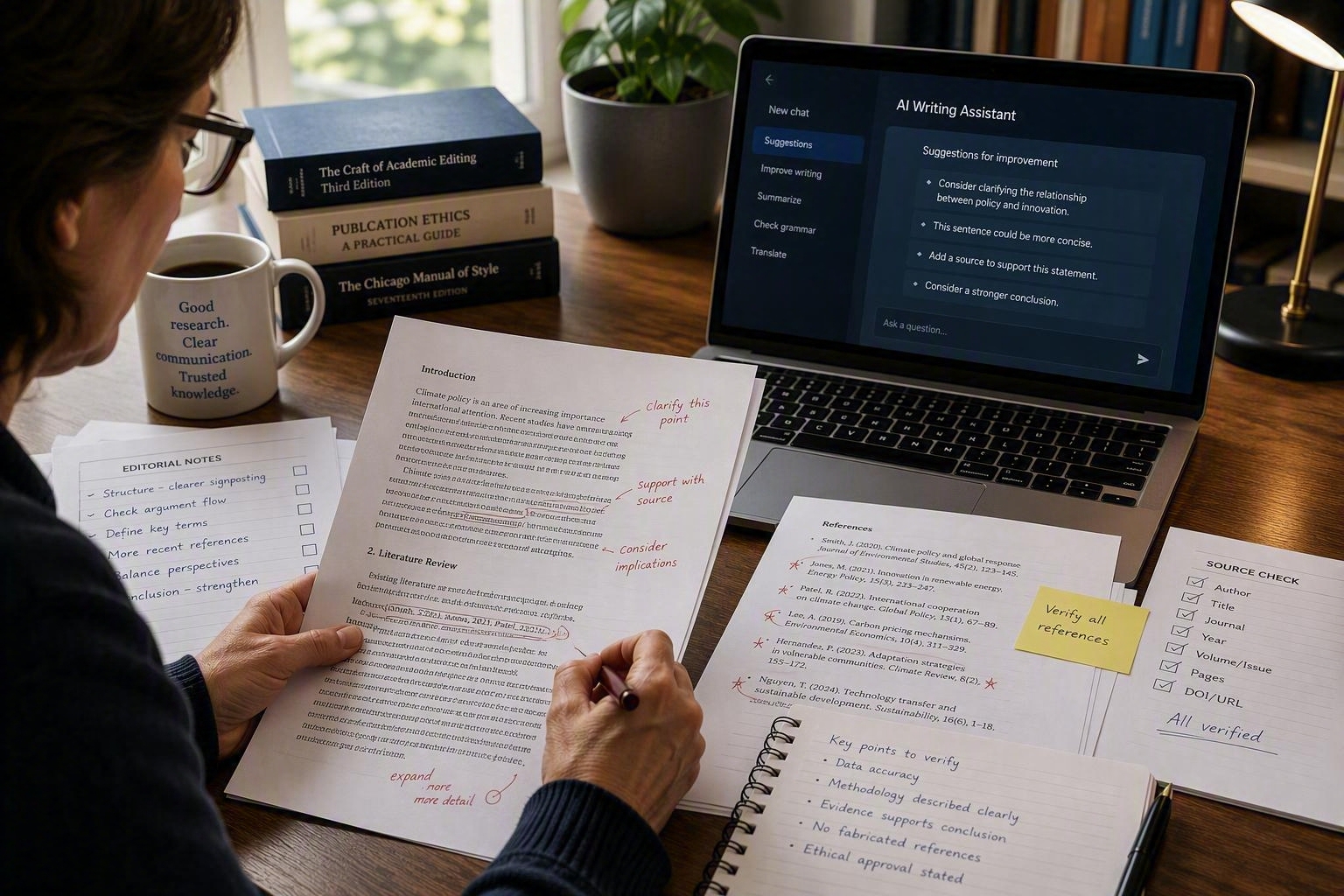
A bibliography can appear comprehensive while containing references that no author has ever written.
That is why I remain sceptical whenever discussions about AI focus solely on whether it will replace proofreading.
If proofreading means correcting spelling, punctuation and grammar, then AI has already assumed a considerable share of that work. Most researchers can see that for themselves.
But scholarly editing was never just about correcting mistakes on a page.
Editors and reviewers evaluate arguments. They spot inconsistencies. They question unsupported assertions. They identify citation problems. They notice when evidence does not support a conclusion. They apply disciplinary knowledge and professional judgement.
These are not simply technical tasks.
They are exercises in scrutiny.
A language model can suggest a stronger sentence. It cannot meaningfully accept responsibility for the accuracy of the claim contained within that sentence. Nor can it be held accountable when a fabricated reference finds its way into the published record.
That responsibility remains with authors and, ultimately, with publishers.
The Cambridge Scholars policy reflects that reality through requirements for source verification, citation checking, editorial screening and investigation of suspicious patterns. It also makes clear that integrity concerns may be investigated after publication where the scholarly record is at risk.
More broadly, this is evidence of a shift taking place across scholarly publishing.
The question is gradually moving away from whether AI should be used. That debate is largely settled. AI is already embedded in academic workflows and is likely to become more capable, not less.
The more difficult question is how much trust publishers can place in content produced with AI assistance, and what safeguards are necessary to maintain confidence in the published record.
That brings us back to a principle that predates AI by many decades.
Academic publishing depends on trust.
Readers trust that sources have been checked. Editors trust that authors are presenting their work honestly. Publishers trust that what appears under an author’s name genuinely reflects that author’s scholarship and judgement.
Technology may help researchers write more efficiently. It may even improve the quality of some manuscripts. But technology does not remove the need for accountability.
If anything, the opposite may be true.
The more AI becomes part of academic writing, the more important it becomes to know who is willing to stand behind what has been written.