Darren Chastney | 16 July 2026
Recent headlines have been buzzing about a curious discovery: researchers have identified a writing habit that appears far more frequently in AI-generated text than in human writing.
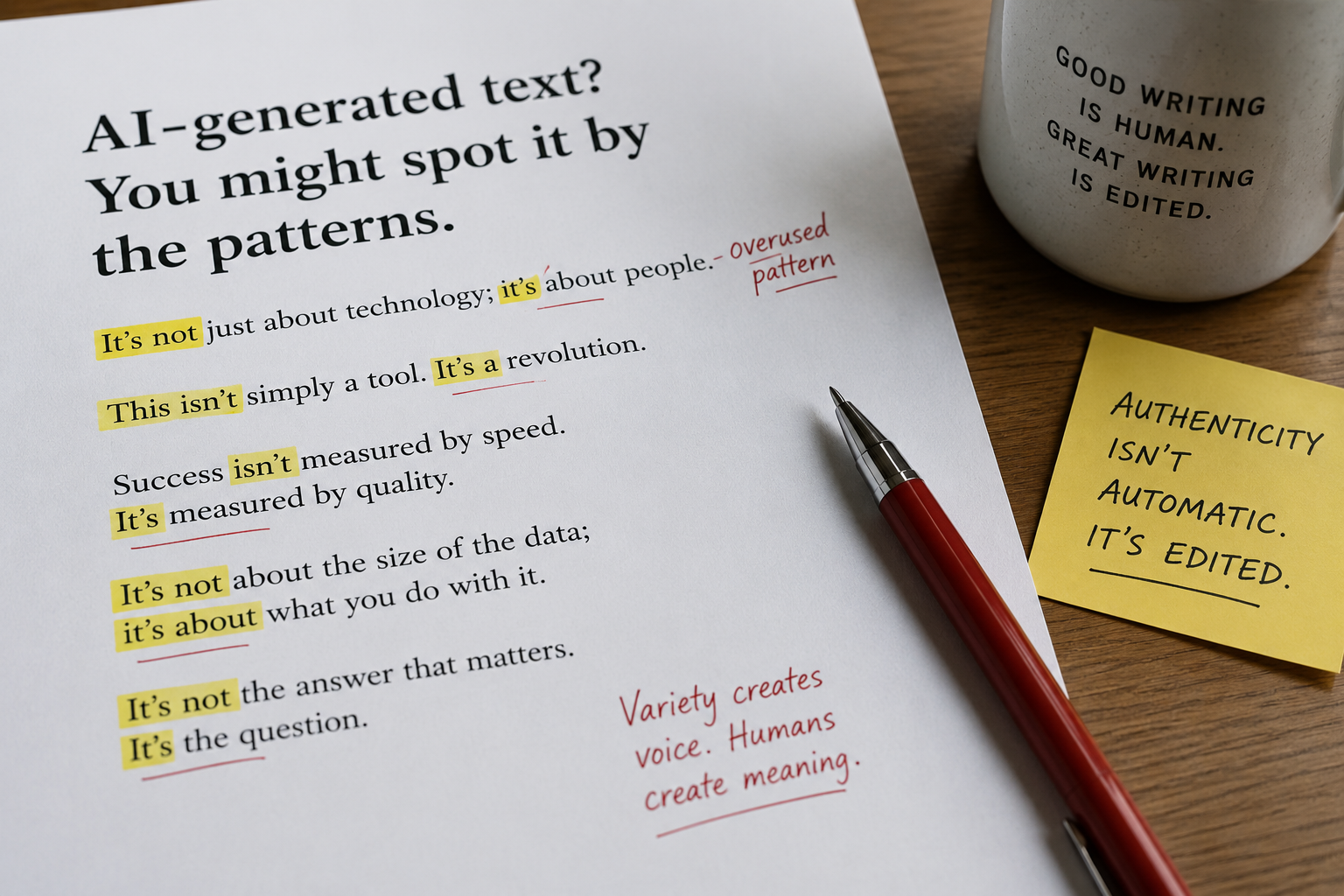
The pattern is called negative parallelism.
You’ve almost certainly seen it.
It’s not just about technology—it’s about people.
This isn’t simply a tool. It’s a revolution.
Success isn’t measured by speed. It’s measured by quality.
There’s nothing grammatically wrong with these constructions. Quite the opposite. Used well, they’re powerful rhetorical devices that create emphasis through contrast. Great writers have been using them for centuries.
The problem isn’t the phrase.
The problem is the repetition.
According to a recent article in The Atlantic, AI language models use these structures around three times more frequently than human writers. Researchers aren’t entirely certain why, but the result is text that feels strangely familiar. Smooth. Persuasive. And increasingly recognisable as AI-generated.
Ironically, this isn’t really an AI problem.
It’s a writing problem.
Large language models learn from patterns. They identify structures that statistically appear persuasive or engaging and reproduce them over and over again. The result is writing that is technically competent but stylistically predictable.
As an editor, this is something I encounter almost every day.
When reviewing AI-assisted translations, marketing copy or academic writing, I rarely find glaring grammatical mistakes. Today’s AI is remarkably good at producing clean, coherent English.
What it struggles with is rhythm.
Human writers vary sentence length. They change emphasis naturally. They surprise the reader. AI tends to fall back on familiar rhetorical patterns because they are statistically “safe”. One repeated construction is harmless. Twenty repetitions across a document become distracting.
The answer isn’t to eliminate negative parallelism altogether.
In fact, I often leave it exactly where it belongs.
The role of an editor isn’t to remove every stylistic flourish or grammatical construction that AI happens to favour. Good editing is about recognising when a technique has become overused and restoring balance, variety and authenticity to the text.
Perhaps the most interesting aspect of this discussion is that these AI habits may already be influencing human writing.
Many of us now draft emails with AI, brainstorm ideas with chatbots or use language models to polish reports. The more we read AI-generated text, the more its rhythms and preferences begin to feel normal. Without realising it, we may even start adopting those patterns ourselves.
Language has always evolved through imitation.
The question is: who—or what—are we now imitating?
For me, this is exactly why human editing has become more valuable, not less.
AI can produce an excellent first draft in seconds. What it cannot yet do consistently is recognise when a piece of writing sounds formulaic, repetitive or just a little too familiar.
That final layer—the judgement that transforms competent writing into compelling communication—still depends on human experience.
Perhaps that’s the real lesson from this latest AI “tell”.
It’s not that AI writes badly.
It’s that good writing has never been about simply following patterns.
It’s about knowing when to break them.
Further reading
If you’re interested in the research behind this discussion, I highly recommend reading the original article in The Atlantic:
The AI Chatbot Writing Tic Everyone Is Talking About
https://www.theatlantic.com/technology/2026/07/ai-chatbot-writing-tic-negative-parallelism/687892/