
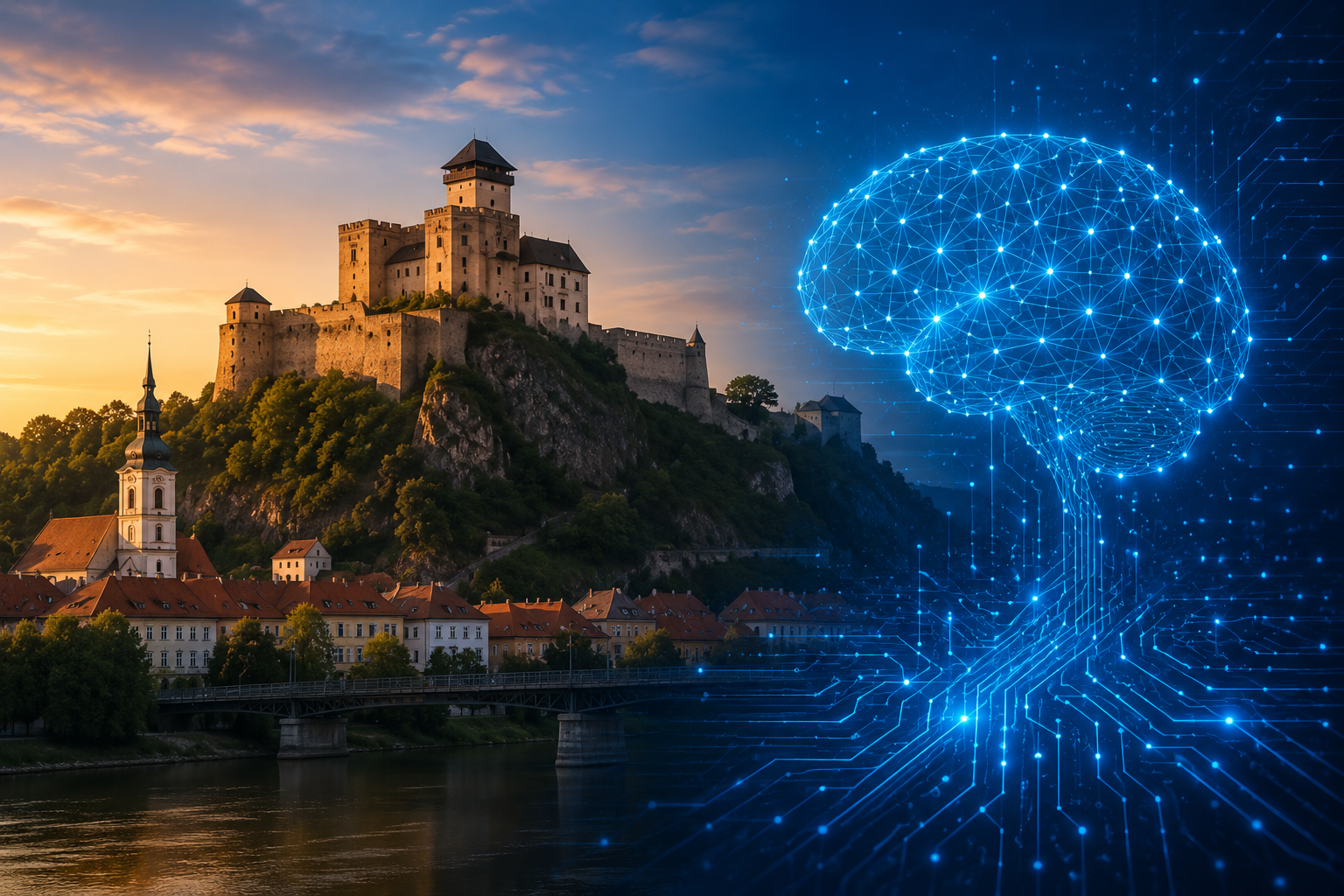
Recent reports highlighting artificial intelligence investment initiatives linked to the Trenčín region raise an important question: can targeted AI investment help reshape Slovakia’s economic future?
Across Europe, governments and regional authorities are increasingly viewing AI not merely as a technological trend, but as a strategic driver of competitiveness, productivity, and long-term economic resilience. Slovakia faces the same challenge confronting many smaller European economies: how to move from being primarily a manufacturing and outsourcing destination towards becoming a creator of high-value knowledge, technology, and innovation.
The Trenčín region offers an interesting case study. Historically associated with industry and manufacturing, it has increasingly positioned itself as a centre for creativity, education, and innovation. The city’s role as a European Capital of Culture 2026 reflects broader ambitions to attract talent, investment, and international attention. Such initiatives can help create the conditions necessary for technology-driven growth, including stronger collaboration between universities, businesses, public institutions, and research organisations.
However, AI investment alone is not enough. Research consistently shows that successful innovation ecosystems depend on several interconnected factors:
- Access to skilled talent and continuous upskilling
- Strong university-industry partnerships
- Support for start-ups and technology transfer
- Availability of venture capital and innovation funding
- Digital infrastructure and data accessibility
- An environment that encourages experimentation and entrepreneurship
Perhaps most importantly, AI investment must be accompanied by investment in people. As automation and AI technologies continue to reshape labour markets, workforce development, reskilling, and lifelong learning become essential components of regional economic strategy. Recent analyses of economic transition programmes in the Trenčín region demonstrate the importance of aligning skills development with future labour market needs.
For academics and researchers, these developments create both opportunities and responsibilities. AI is no longer solely a computer science issue. Questions surrounding ethics, governance, language, education, social impact, public policy, and human-AI collaboration require expertise from across disciplines.
The key challenge for Slovakia is therefore not whether to invest in AI, but how to build an ecosystem in which technology investment, research excellence, education, and regional development reinforce one another.
If successful, initiatives emerging from regions such as Trenčín could serve as valuable models for how smaller European economies can leverage AI to strengthen competitiveness while ensuring that innovation remains inclusive, sustainable, and human-centred.
The coming years will reveal whether these ambitions translate into lasting economic and societal impact. What is already clear, however, is that the conversation about AI in Slovakia is moving beyond technology itself and towards the broader question of how innovation can shape the country’s future.
Inspiration: https://planet.news/article/slovakia-ai-investment-trencin-budget-travel-2026