Artificial intelligence is transforming the way we create, publish, translate, and consume content. Yet one of the most important questions remains unresolved:
Who should benefit when AI systems are trained on the work of others?
As part of my current editorial work with LITA (the Slovak Literary and Information Centre), I have been following ongoing discussions about the impact of AI on writers, screenwriters, translators, academics, and other creators whose works are increasingly being used to train generative AI systems.
The concern is not that AI exists. The concern is how it learns.
Most AI systems rely on vast quantities of data that may include copyrighted books, articles, scripts, research papers, and other creative works. In many cases, the individuals who produced this content were never asked for permission, informed that their work was being used, or compensated for its contribution to AI training.
Within the European Union, the Directive on Copyright in the Digital Single Market introduced an exception for text and data mining (TDM). Under certain conditions, copyrighted works may be used for data extraction without authorisation and without financial compensation to authors.
To address this imbalance, organisations such as LITA introduced an opt-out mechanism in 2025, allowing rights holders to explicitly reserve their works from certain forms of AI training and data mining.
While public attention often focuses on novelists, journalists, and screenwriters, the same questions apply to academia. Research articles, conference papers, books, and scholarly publications represent intellectual property created through years of specialised work. Many researchers are now asking whether their contributions should also be subject to greater transparency, consent mechanisms, and fair-use safeguards when incorporated into AI training datasets.
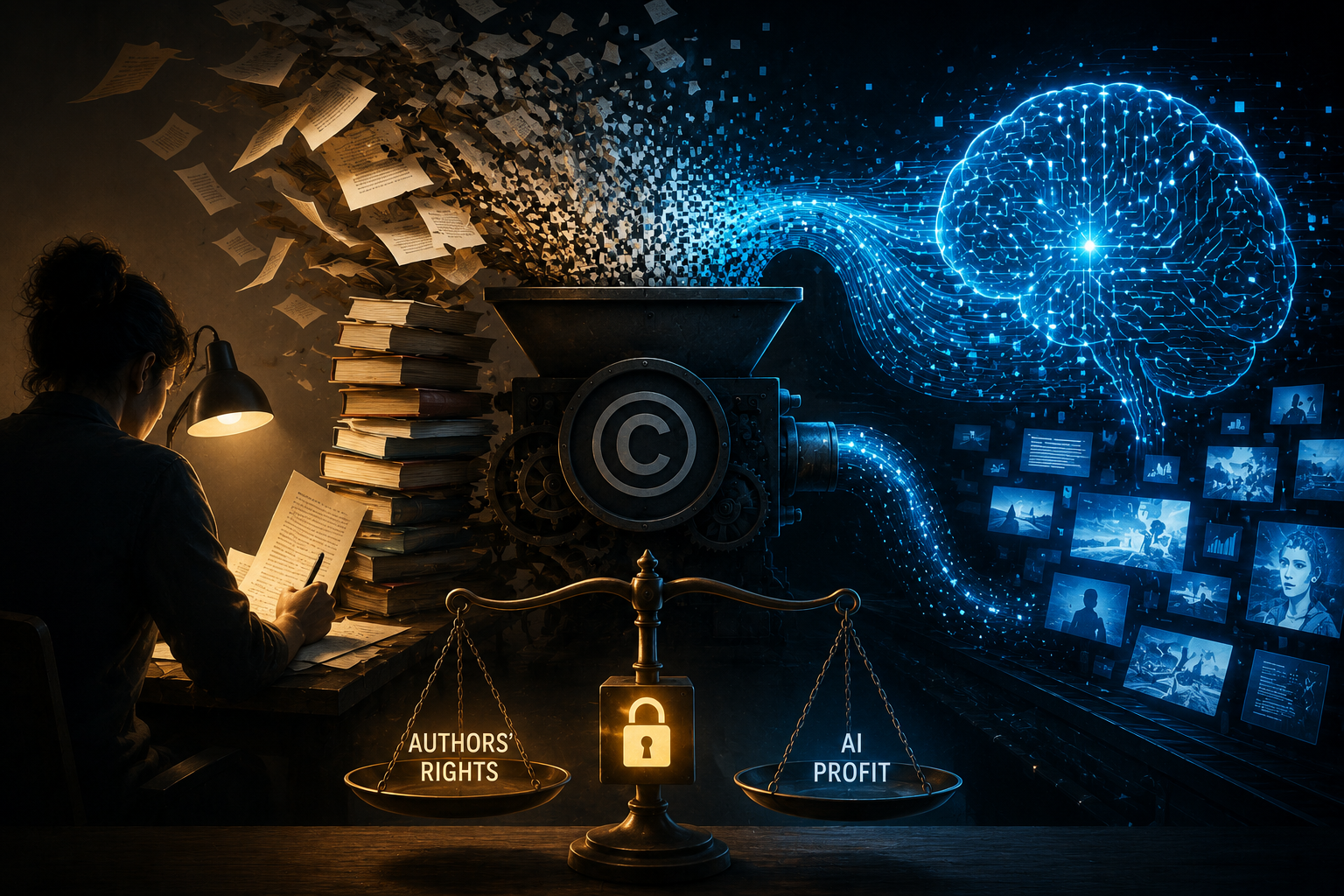
The challenge now is finding a workable balance.
AI developers need access to data. Authors, researchers, and other creators deserve transparency, consent, and fair remuneration. Future solutions may include licensing frameworks, collective rights management, clearer disclosure obligations, and stronger international standards governing the use of creative works for AI training.
Innovation and authors’ rights do not have to be opposing forces. But if trust is to be maintained, both must be protected.